
Last Updated: November 24, 2026
Quick Summary
You choose beginner motorcycle gear by covering five categories in priority order: a DOT-approved full-face helmet, an armored jacket, riding pants with knee armor, full-finger gloves, and over-the-ankle boots. Buy the helmet first and never compromise on it, then upgrade the rest as you learn how you ride.
- A helmet should press firmly against your cheeks and forehead without pinching or pressure points.
- The HJC C10 full-face helmet is DOT approved, comes in four shell sizes, and costs $119.99.
- Textile with CE armor is often a practical first jacket, with leather as a later purchase.
- Buy the helmet and gloves in week one, then add jacket and pants before your first highway ride.
- Replace any helmet that has been in a crash, dropped hard, or is past its service life.
Table of Contents
- How do you choose beginner motorcycle gear?
- Your beginner motorcycle gear checklist, in priority order
- How to choose a motorcycle helmet that fits and protects
- Jackets, pants, and armor: building a motorcycle protective gear set
- Gloves and boots: the protection riders skip first
- Leather vs. textile: pros and cons for real riding conditions
- The best motorcycle gear for beginners women riders
- Budget tiers and a prioritized buying plan
- Gear care, inspection, and when to replace it
- Trying on gear at Santa Clara Cycle before your first ride
- Frequently Asked Questions
How do you choose beginner motorcycle gear?
You choose beginner motorcycle gear by covering five categories in priority order: a DOT-approved full-face helmet, an armored jacket, riding pants with knee armor, full-finger gloves, and over-the-ankle boots. Buy the helmet first and never compromise on it. Everything else can be upgraded as you learn how you actually ride.
Many new riders walk in wearing a borrowed jacket and a helmet from a garage sale. The gear isn't the fun part of motorcycling. It's the part that decides how your first year goes.
Here's the good news: you don't need to spend a fortune. You need to buy the right five items in the right order, and you need them to fit properly. Below, we'll show you exactly how to do that, category by category, with the fit checks that matter and the mistakes that cost riders real money.
Your beginner motorcycle gear checklist, in priority order
A beginner motorcycle gear checklist has five non-negotiable items, ranked by how much protection each delivers per dollar. The helmet comes first because head injuries are the least survivable. Boots and gloves come last only because they're cheaper to replace, not because they matter less.
Here's the order we'd buy in:
- DOT-approved full-face helmet: your single most important purchase
- Armored riding jacket: torso, shoulders, elbows, and back
- Riding pants or protective jeans: knee and hip armor plus abrasion resistance
- Full-finger gloves with knuckle protection: your hands hit the ground first
- Over-the-ankle boots: ankle and toe protection with a reinforced sole
A common mistake is buying the jacket first because it's the most visible piece. Don't. A cheap helmet is a false economy, and a good helmet at a fair price is the best money you'll spend all year.
How to choose a motorcycle helmet that fits and protects
To choose a motorcycle helmet, work through three gates in order: certification, fit, then features. In the United States, the baseline is the DOT certification label, which manufacturers affix to the back of the shell to indicate compliance with the federal motorcycle helmet standard. That label is self-certified by the manufacturer, so treat it as a minimum, not a guarantee. A full-face helmet gives you chin and face protection that an open-face design cannot, and that is the difference that matters most in a crash.
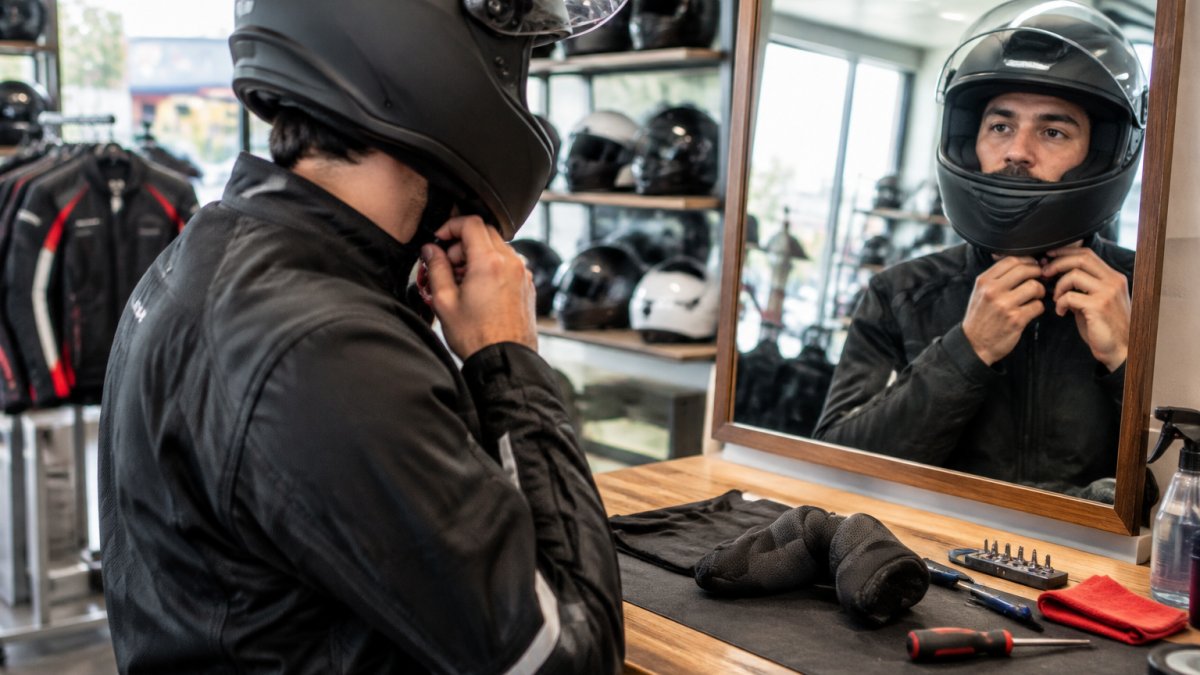
Fit is where most beginners get it wrong, and it is the one thing you cannot fix later. A helmet should press firmly against your cheeks and forehead without pinching or creating pressure points. It should not rotate freely when you grab the chin bar and twist.
Use this fit-check sequence in the shop, in this order:
- Measure before you try. Wrap a soft tape around your head about an inch above your eyebrows and across the widest part of the back of your skull. Write the number down. Every brand publishes a size chart keyed to that circumference, and the chart is the starting point, not the answer.
- Check the crown. With the helmet on and the chin strap snug, rock your head forward and back. The liner should move with your scalp. If the shell shifts independently of your skin, the fit is too loose.
- Check the cheeks. Bite down gently. Your cheeks should press into the liner and the liner should press back. A helmet that feels comfortable and roomy in the showroom is usually a size too large once the liner breaks in.
- Check the roll-off. Grab the chin bar with both hands and try to roll the helmet forward off your head. It should not come off. Then try to roll it backward. Same result.
- Check the pressure points. Leave it on for five full minutes. Hot spots at the forehead, temples, or crown will become headaches at highway speed. A snug fit is not the same as a painful one.
- Check the strap and visor. The chin strap should sit flat against your jaw with no twist, and the visor should seal against the eye port without gaps that whistle at speed.
Shell size matters as much as liner size. A helmet offered in several shell sizes, like the HJC C10 White Full-Face Motorcycle Helmet, can help you get a closer match to your head size. The C10 is DOT approved, built on an advanced polycarbonate composite shell, and comes in four shell sizes including youth fit.
Watch out: be cautious with a used helmet of unknown history. A helmet that has been dropped or crashed can have a compromised shell that looks fine from the outside.
Jackets, pants, and armor: building a motorcycle protective gear set
A motorcycle protective gear set is a jacket, pants, and armor working together as one system, not three separate purchases. The jacket covers your torso, arms, and back. The pants cover your legs and hips. Armor at the shoulders, elbows, back, knees, and hips absorbs impact energy at the points that hit first.
Textile jackets with CE-rated armor are the practical starting point for most beginners. Look for armor at the shoulders and elbows at minimum, and a back protector pocket you can fill later. Ventilation matters more than you'd think: a jacket you sweat through is a jacket you'll stop wearing.
For pants, the NORU Atlas Motorcycle Cargo Pants show what to look for: aramid reinforcement at the seat, knees, and hips for abrasion resistance, CE Level 1 knee armor, and airflow mesh lining. At $89.99, they're a realistic first pair of riding pants that don't look like a track suit.
If you want a jacket to pair with them, the Noru Kuki Mesh Black Motorcycle Jacket is an affordable mesh option with armor built in, and the Noru Taifu Waterproof Motorcycle Pants cover the wet-weather riding that catches new commuters off guard.
Gloves and boots: the protection riders skip first
Gloves and boots are the two categories beginners skip, and they're the two your body reaches for first in a fall. Hands go out instinctively. Feet get trapped under the bike. Neither injury is one you want to learn about the hard way.
For gloves, full-finger coverage with a hard knuckle protector is the baseline. Palm abrasion resistance matters just as much as knuckle protection, because your palms take the slide.
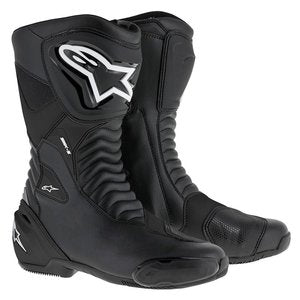
Boots need to cover the ankle and have a reinforced sole and toe box. The Alpinestars SMX-S Men's Motorcycle Boot is CE certified to EN 13634:2017, with a TPU shin plate, heel counter, and external ankle brace. At $299.95 it's a significant investment.
Watch out: sneakers offer zero ankle protection and their soles flex in ways a motorcycle peg doesn't forgive. If you're riding in them, you're one low-speed tip-over from a broken ankle.
Leather vs. textile: pros and cons for real riding conditions
Leather wins on abrasion resistance. Textile wins on versatility, weather handling, and price. For a beginner riding in mixed traffic and weekend runs, textile with CE armor is often a practical first jacket, and leather can become a second purchase once you know your riding style.
| Material | Abrasion Resistance | Weather Handling | Ventilation | Cost | Best For |
|---|---|---|---|---|---|
| Leather | Highest | Poor when wet | Limited unless perforated | Higher | Dedicated sport and canyon riding |
| Textile | Good with aramid or SuperFabric panels | Good with waterproof liners | Strong with mesh | Lower | Commuting, mixed weather, everyday riding |
| Mesh textile | Moderate | Needs a rain layer | Best in heat | Lowest | Hot-climate commuting |
The honest trade-off: leather protects better in a slide but punishes you in summer traffic and rain. Textile with reinforced panels gets you most of the abrasion resistance with far more comfort. A mid-priced textile jacket with good armor can offer more practical protection than an expensive leather jacket with no back protector.
The best motorcycle gear for beginners women riders
The best motorcycle gear for beginners women riders is gear cut for a woman's proportions, not a men's small. Shoulder width, torso length, hip shape, and hand size all differ, and gear that doesn't fit those differences won't protect you the way it should.
Look for women's-specific patterns in jackets and pants, and check that the armor sits over your actual joints, not above or below them. A shoulder pad that floats an inch off your shoulder does nothing in a fall.
For hands, the Alpinestars Stella SMX1 Air Women's Motorcycle Glove is built for an optimized women's performance fit, with 3D mesh inserts on the top hand for internal airflow.
Try everything on with the riding position in mind. Sit on a bike, reach for the bars, and put your feet on the pegs.
Budget tiers and a prioritized buying plan
A realistic beginner motorcycle gear budget can be planned in three tiers: essentials, complete, and all-weather. Buy the essentials first, ride for a season, then upgrade the pieces you actually use hardest. The tiers below are a spending plan, not a shopping list, and the order matters more than the total.
| Tier | What's Included | What It Covers | Buy This If |
|---|---|---|---|
| Essentials | DOT full-face helmet, armored gloves, over-ankle boots | Head, hands, feet | You're buying your first bike this month |
| Complete | Essentials plus armored jacket and riding pants | Full body | You're riding daily or on highways |
| All-weather | Complete plus waterproof layers and a back protector | Full body, rain, cold | You commute year-round |
The prioritized buying plan is simple. Buy the helmet and gloves in week one. Add the jacket and pants before your first highway ride. Add boots and a back protector before your first wet-weather commute.
What most guides skip is the minimum protection criteria for each item, which is what actually determines whether a budget purchase is safe. Use these as your floor, not your target:
- Helmet: DOT certification label present, full-face coverage, and a shell that passes the roll-off check above.
- Jacket: armor at shoulders and elbows at minimum, a back protector pocket, and abrasion-resistant panels at the impact zones. A mesh jacket with no armor is a windbreaker, not riding gear.
- Pants: knee armor and abrasion reinforcement at the seat and hips. Denim alone does not qualify unless it is reinforced.
- Gloves: full-finger coverage, a hard knuckle protector, and a palm that resists abrasion. Half-finger gloves are not riding gloves.
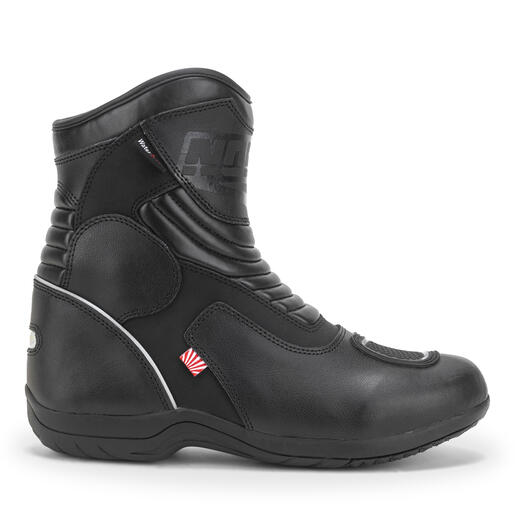
- Boots: over-the-ankle coverage, a reinforced toe box, and a sole stiff enough that it does not fold over a peg.
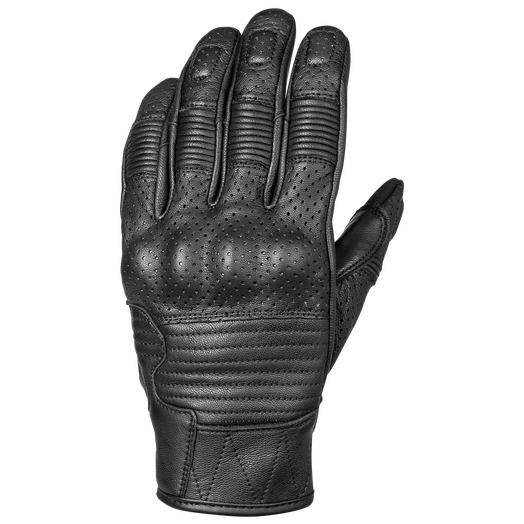
Gloves are often overlooked in budgeting, even though your hands hit the ground first. A $79.99 glove like the Cortech Revo RR V2, with cowhide, a goat leather palm, carbon fiber knuckles, and SuperFabric reinforcements, is one example of an affordable option for the hands.
Watch out: do not let a sale price override the minimum criteria. A discounted jacket with no elbow armor is still a jacket with no elbow armor, and the money you save is money you will spend on the upgrade anyway.
Prices of listed beginner motorcycle gear items
Gear care, inspection, and when to replace it
Inspect your gear every few months and after any drop, and replace anything that has taken a real impact. A helmet that has hit the pavement in a crash is done, even if the shell looks intact. Gloves wear through at the palm and fingertips first. Boots lose their sole grip and their ankle structure over time.
- Check the helmet shell for cracks, and the liner for compression at the crown
- Inspect glove palms and finger seams for thinning leather
- Look at jacket and pant armor: is it still seated over your joints?
- Check boot soles for wear and ankle support for looseness
- Replace any helmet that has been in a crash, dropped hard, or is past its manufacturer's service life
Clean textile gear with a mild detergent and no fabric softener, which degrades the abrasion-resistant fibers. Leather needs conditioner to stay supple. Store everything dry and out of direct sun, and never leave a helmet baking on a hot seat.
Trying on gear at Santa Clara Cycle before your first ride
The last step is the one online shopping can't do for you: try the gear on, on a bike, before you commit. Fit is the whole game with beginner motorcycle gear, and a helmet or jacket that fits in a chair may not fit in a riding position.
We've been a family-owned and operated shop for over 25 years. Our team can help you with sizing and with checking how gear sits on your body. If you're also sorting out tires, we offer free mounting with purchase, and our service team handles routine maintenance and repairs.
Your first season of riding depends on five pieces of gear that fit properly and protect the right places. Santa Clara Cycle carries a wide inventory of helmets, jackets, pants, gloves, and boots, and our team will help you match each piece to your body and your riding style. Get started with Santa Clara Cycle and ride your first mile with gear you trust.
Frequently Asked Questions
What gear should I get as a beginner motorcycle rider?
Start with five items: a DOT-approved full-face helmet, an armored jacket, full-finger gloves, riding pants with knee armor, and over-the-ankle boots. That covers the head, torso, hands, legs, and ankles in the order injuries tend to happen. At Santa Clara Cycle, a DOT-approved HJC C10 full-face helmet runs $119.99, and the Cortech Revo RR V2 gloves are $79.99. Buy all five before your first ride rather than adding pieces later.
How should beginner motorcycle gear fit?
Snug, not tight. A helmet should press your cheeks and stay put when you shake your head, with no hot spots after 15 minutes. Jacket armor should sit over the shoulder, elbow, and back without sliding when you twist your arms. Gloves should leave no slack at the fingertips but not pinch the webbing. Boots should lock your heel down and let you shift without lifting your foot. If any piece moves freely, size down or adjust it.
How much does beginner motorcycle gear cost?
The listed items in this guide are priced at Santa Clara Cycle as follows. The HJC C10 helmet is $119.99 to $129.99, the NORU Atlas cargo pants are $89.99, the Cortech Revo RR V2 gloves are $79.99, and the Alpinestars SMX-S boots are $299.95. A jacket rounds out the set. Buy the helmet and gloves first, then add the jacket, pants, and boots as budget allows.
What motorcycle gear do you need to ride legally?
Legal minimums vary by state, but a DOT-approved helmet is the most common requirement and the one most worth meeting regardless of the law. Many states require eye protection, and some require a helmet for riders under a certain age only. Check your state's motorcycle handbook before your first ride. A DOT-approved full-face helmet like the HJC C10 satisfies the helmet requirement and gives you more coverage than a half helmet.
Is a motorcycle protective gear set a good choice for beginners?
Yes, if the pieces fit you individually rather than looking good as a bundle. A matched set from one brand usually shares armor placement and sizing logic, which makes fit easier to predict. The catch is that a set is only as good as its weakest piece: check that the jacket has back armor, the pants have knee armor, and the helmet carries DOT approval. Try each piece on before committing to the set.
What is the best motorcycle gear for beginners women?
The same five categories, sized for a shorter or narrower frame. Look for helmets in smaller shell sizes so the helmet does not sit too high, jackets with adjustable waist straps, and pants with a shorter inseam or a darted knee so the armor lands on the knee rather than the shin. Gloves and boots often need a smaller size than men's equivalents. Try gear on in person when you can, because women's sizing varies widely between brands.
